AnnotateAnything
Automatic Annotation of 3D Assets for Robot Manipulation
Abstract
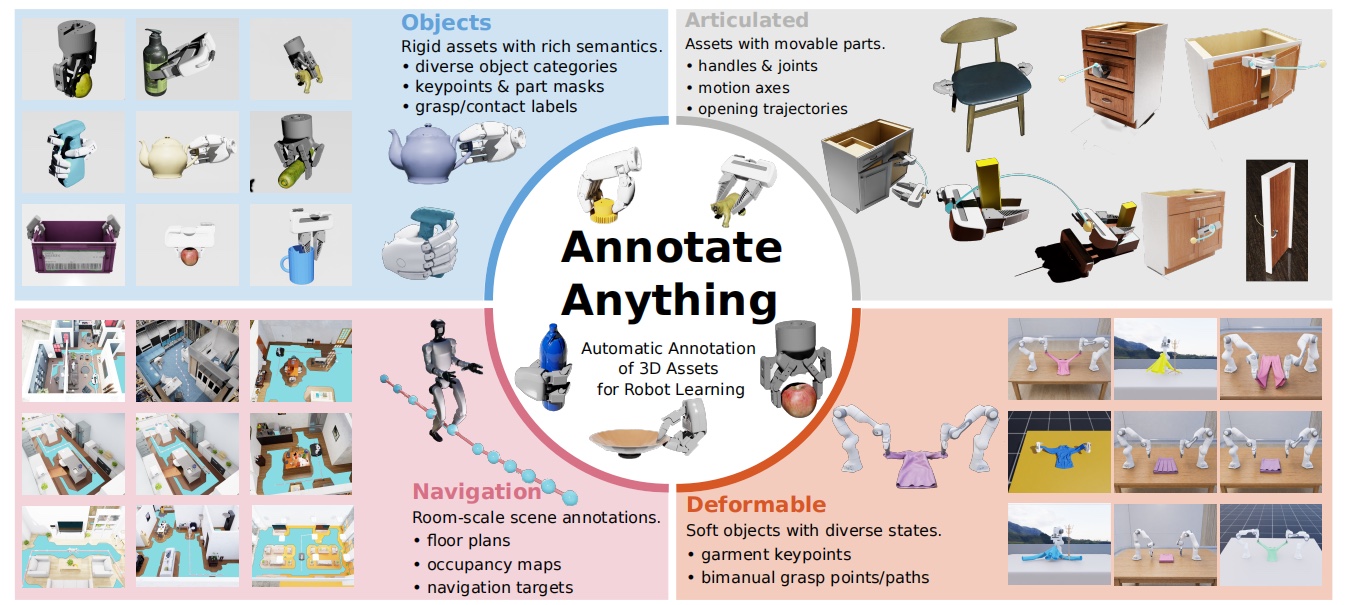
Simulation enables scalable robot data collection, but 3D assets often lack the interaction annotations needed to specify where and how robots should act. We present AnnotateAnything, an automatic framework that converts passive 3D assets into manipulation-ready assets with language, 3D visual, and executable action annotations. A vision-language model supplies interaction priors (functional parts, keypoints, affordance regions, and compatible skills) that are grounded in each asset's 3D geometry. A physics annotation pipeline converts these priors into action candidates through skill-specific generation, geometric optimization, and GPU-parallel validation, retaining multiple solutions in reusable candidate banks. These banks drive an asynchronous parallel simulation data-collection system. Applied to 17,005 rigid, articulated, deformable, and room-scale assets, the framework produces about 100M validated action annotations across nine skill families. On an audited simulation suite, it achieves higher readiness and full-robot execution success than ablations and framework-adapted baselines, as well as higher annotation and collection throughput than the latter. Pretrained policies fine-tuned solely on the generated simulation demonstrations achieve 70.8% mean success across six real-world tasks on three robot platforms, with 20 trials per task.
Method overview
Visual-language annotation
A VLM names parts, grounds keypoints and affordance regions on the asset's 3D geometry, and infers which skills each region supports. Rooms add occupancy maps and floor plans.
Physics annotation
Skill-specific generators turn each anchor into contacts, poses, and trajectories, which are optimized and filtered by GPU-parallel physics validation into a bank of multiple valid solutions.
Skill-consumable data
Reusable atomic skills query the bank, fall back to another candidate when one is infeasible for the scene or robot, and collect simulation data at scale.
Demos
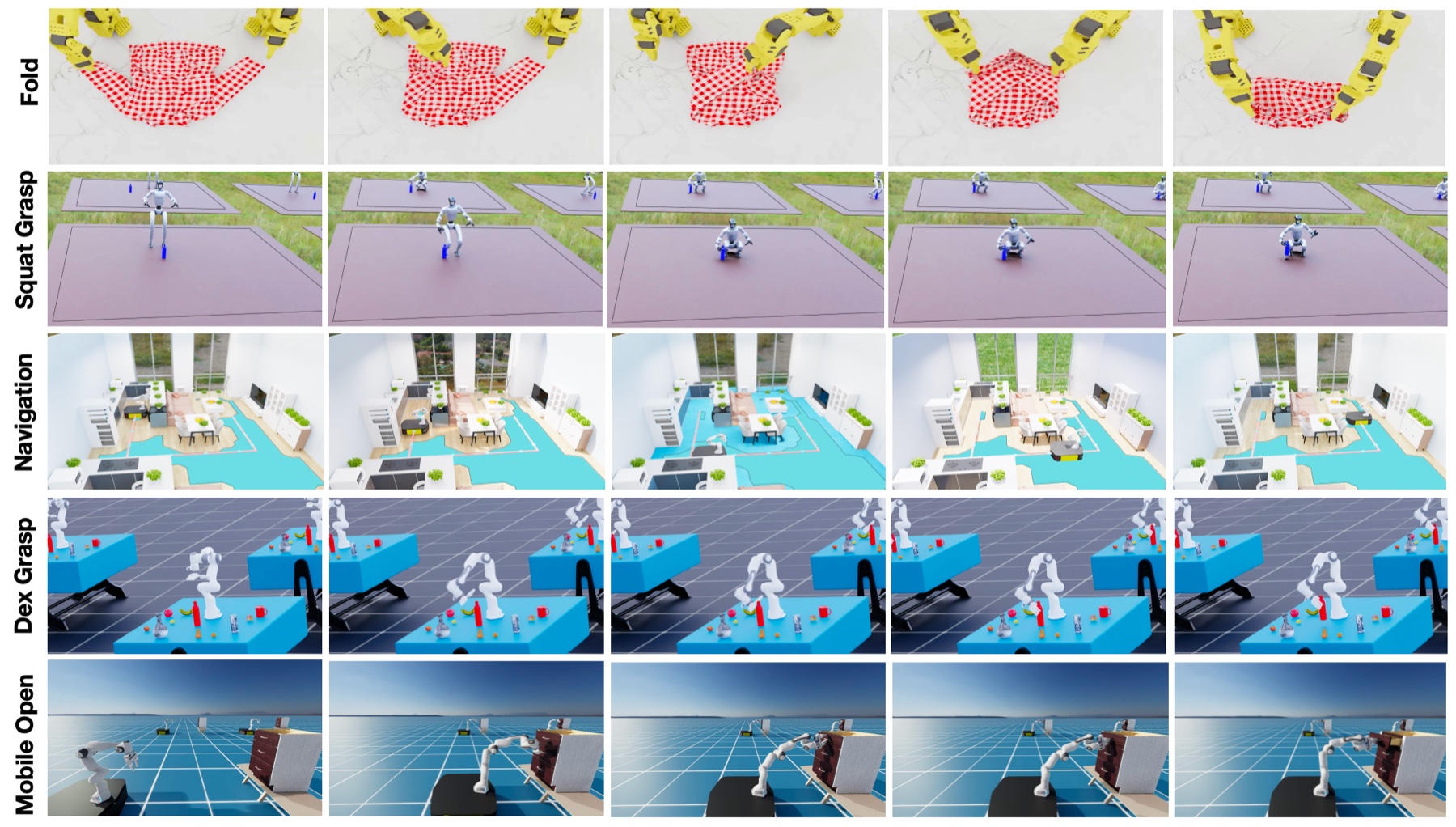
Annotation-enabled rollouts across articulated objects, dexterous and parallel grippers, and bimanual skills.
Annotation types
| Level | Annotation | Example outputs |
|---|---|---|
| Asset | Language | Sparse tags; object-, part-, and task-level descriptions |
| Asset | Visual | 3D keypoints; part masks; affordance regions |
| Room | Language | Scene descriptions; object relations; task contexts |
| Room | Visual | Occupancy maps; floor plans; top-view layouts |
| Action | Manipulation | Grasps; dexterous contacts; articulation waypoints; insertion and hanging poses; garment trajectories |
| Action | Scene | Navigation targets; approach poses; interaction-ready base poses |
Results
Evaluated on an audited suite of 1,160 assets and 3,698 asset–skill pairs.
of parts and affordance regions match manual references; +21 points over direct VLM prediction in human-rated quality.
of ready pairs execute on the complete robot, versus 67.5% for the strongest ablation.
distinct grasp modes per median asset; one fallback raises dexterous-grasp execution from 87.2% to 93.9%.
validated annotations over 17,005 assets from nine sources and nine skill families.
Against framework-adapted pipelines (ManiTwin, RoboGen, MolmoBot, GenManip) and a protocol-matched BODex dexterous-grasp baseline, the bank yields higher readiness and full-robot execution. Full tables are in the paper.
Real-world evaluation
Policies are fine-tuned only on bank-driven simulation demonstrations (200 per task) in digital twins and deployed without task-specific real-world demonstrations or real-world fine-tuning; 20 independently reset trials per task.
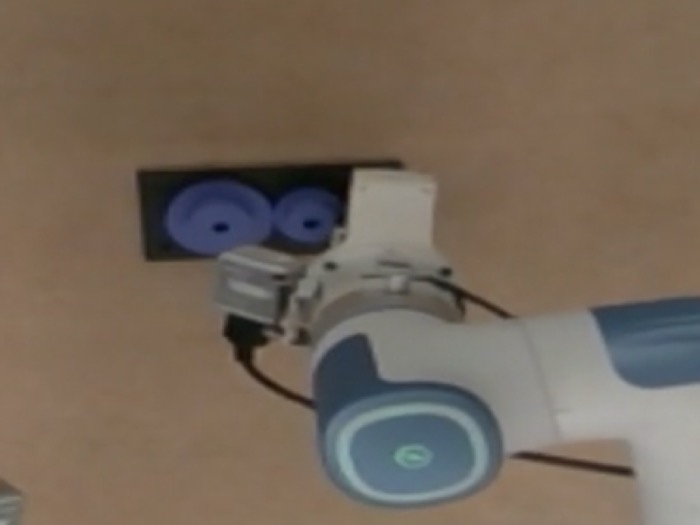
Mean success 70.8% (85/120 trials).
Videos added in the revision
More constrained PiPER-X tasks
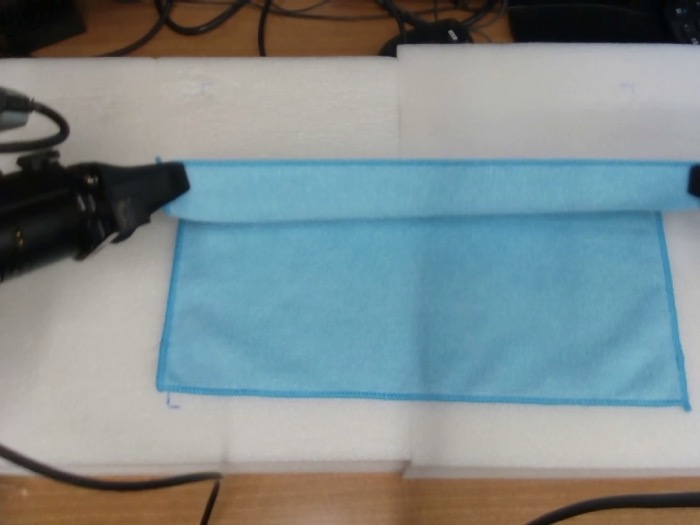
Policies are again trained only on simulation data and deployed without real-world demonstrations or real-world fine-tuning. Mug pick-and-place succeeds in 13/20 trials and T-shirt folding in 4/10 (towel: 15/20). These two tasks are reported separately and are not included in the six-task results above.
Real-robot audit of the grasp validator
We executed 300 grasps with a PiPER-X arm on six real objects (two mugs, two bottles, a screwdriver, and an apple; 50 poses each, both accepted and rejected by the validator). Simulation and robot agree on 258/300 grasps (86.0%); 144 of the 156 accepted grasps succeed on the robot (92.3%), and 114 of the 144 rejected ones fail (79.2%). In each clip, the left panel shows the real grasp and lift and the right panel the same grasp in simulation.